Paraguay: Residency option for South Africans and Digital Nomads
Paraguay Residency and Tax Guide for South Africans and Digital Nomads (2026)
Topics covered: Paraguay residency requirements | Paraguay tax system for expats | South African emigration options | Paraguay vs Portugal vs Mexico | Paraguay permanent residency | Paraguay passport strength | Paraguay fun facts
Why Paraguay Deserves Your Attention
Paraguay is one of South America’s least talked-about countries — and that’s a big part of its appeal. It hasn’t been flooded with expats and digital nomads yet, which means prices are still genuinely affordable and the bureaucracy hasn’t caught up with demand. It’s gaining serious traction as a “Plan B” destination, and increasingly as a primary base, for South Africans and location-independent workers.
If you’re looking for a clean, low-tax jurisdiction with a simple residency path and no minimum stay requirement, Paraguay is one of the best options available right now — and most people haven’t heard of it.
The Tax Case — This Is the Big One
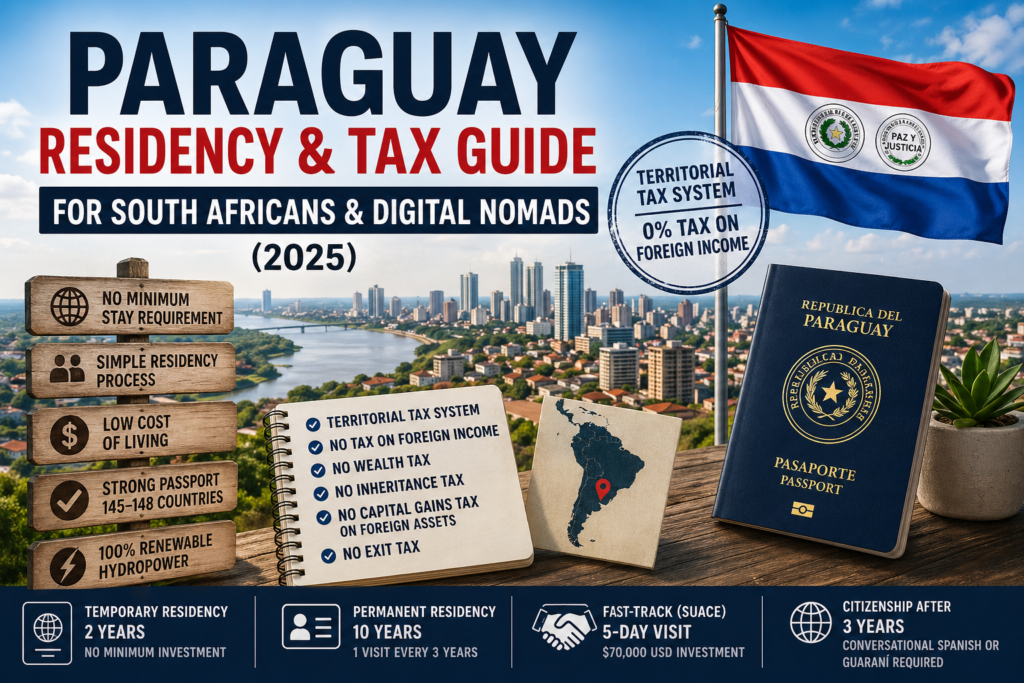
Paraguay operates a territorial tax system, meaning only income generated inside the country is subject to tax. Income from outside Paraguay — retirement funds, investment dividends, employment income, business profits from foreign clients — is not taxed in Paraguay at all.
Even on locally-sourced income, the rate is just 10% personal income tax — though most digital nomads and global investors have no locally-sourced income in Paraguay in the first place.
There is no wealth tax, no inheritance tax, no capital gains tax on foreign assets, and no exit tax.
One nuance worth knowing: even if all your income is foreign-sourced, once you establish tax residency you are still expected to register with Paraguay’s tax authority (the SET) and obtain a RUC (tax ID number). Some experts advise filing a zero-income return annually to maintain clean compliance. Speak to a Paraguay-based tax advisor to structure this correctly — the rules are straightforward, but you want them documented properly.
Why this matters specifically for South Africans: South Africa operates a residence-based tax system that taxes worldwide income. Formally establishing tax residency elsewhere — legally — is one of the main ways South Africans manage this exposure. Paraguay is one of the cleanest options available, with a simple process and no minimum physical stay requirement to maintain your residency.
Also worth noting: Paraguay has not implemented the OECD Common Reporting Standard (CRS), meaning financial data is not automatically shared with foreign tax authorities. This is a legitimate point to discuss with your South African tax attorney alongside your formal emigration process.
Are South Africans Eligible?
Yes — and this is a specific advantage worth highlighting.
The standard temporary residency route works for people from OECD and Western countries, which includes South Africans. Many nationals from developing countries outside Latin America, Europe, and South Africa are generally not eligible for the standard route. South African passport holders sit in a favourable category.
Most Europeans and North Americans entering Paraguay visa-free still need to pay an “abono” fee to skip the visa requirement during the residency application process. South Africans should verify their current classification with a facilitator before travelling, as rules can be updated.
How the Residency Process Works
Step 1 — Temporary Residency (2 Years)
No minimum investment is required for the standard temporary residency route — unlike most countries demanding $100,000 or more.
The 2022 immigration reform (Decree N°6984/22), updated again in September 2024, removed previous requirements such as financial solvency demonstrations, making temporary residency one of the most accessible in the world.
Documents required (all apostilled and translated into Spanish):
- Valid passport (6+ months validity)
- Criminal background check from home country
- Birth certificate
- Marriage or divorce certificate if applicable
- Medical certificate
Important: Translations must be done in Paraguay by judiciary-authorised translators. Pre-travel translations are not accepted.
Plan to spend at least one week in Paraguay to complete the application. Working with a residency facilitator is strongly recommended for first-timers.
If you use an agent, the full process typically takes about 6 weeks, with fees ranging from $1,200 to $2,300 USD. Applications are generally approved within 60–90 days.
Step 2 — Permanent Residency (10 Years)
After 21 months of temporary residency, you become eligible to apply for permanent residency, valid for 10 years.
Once you have permanent residency, you can keep it active by visiting Paraguay just once every three years.
On approval you receive a Cédula (national ID card) and a tax ID number (RUC).
Fast-Track: Residency by Investment (SUACE)
With just a 5-day visit and a qualifying investment or business setup via the SUACE program, applicants can receive 10-year permanent residence and a Cédula directly — skipping the temporary residency phase entirely.
The investment route requires a business plan and approximately $70,000 USD committed to a local business. Authorities are generally not strict about the exact number of local employees required.
Cost of Living — What to Expect
- A solo remote worker can live comfortably in Asunción for $700–$1,000 per month
- Capital city apartment rentals can be found for under $400/month
- Healthcare is affordable, and foreign nationals have the same property rights as locals
Paraguay is genuinely one of the most affordable countries in South America for this level of infrastructure and legal stability.
Life on the Ground
Asunción is the capital — it has reliable internet, a growing coworking culture, and is increasingly seen as a digital nomad hub. It offers a real alternative to more saturated (and more expensive) destinations like Bali or Medellín.
Ciudad del Este, Paraguay’s second city on the Brazilian border, has a more relaxed atmosphere with easy access to Iguazú Falls and Argentina.
Languages: Spanish and Guaraní. Basic Spanish is very helpful — most government offices don’t operate in English.
Challenges to be aware of: processing delays, occasionally changing regulations, language barriers, and infrastructure that is less developed than neighbours like Argentina or Uruguay.
Climate: Hot and humid from October to April.
The Long Game — Citizenship
After three years of permanent residency, you can apply for Paraguayan naturalisation. Requirements include conversational fluency in Spanish or Guaraní, basic knowledge of the Constitution, and demonstrated integration and physical presence.
The passport payoff: A Paraguayan passport currently provides visa-free or visa-on-arrival access to approximately 145–148 countries, including the entire EU Schengen zone, the UK (via ETA), Singapore, and South Korea — placing it around the 26th–30th ranked passport globally depending on the index used.
For context, the South African passport currently covers around 102 countries visa-free. A Paraguayan passport represents a meaningful and practical upgrade.
Paraguay vs. Other Options
| Destination | Min. Investment | Process Complexity | Stay Requirement | Tax System |
|---|---|---|---|---|
| Paraguay | None (standard route) | Low | None | Territorial (0% on foreign income) |
| Portugal D7 | Proof of income | Medium–High | 7 days/yr minimum | Worldwide |
| Mexico Temporary | None | Low–Medium | None | Worldwide |
| Panama | $5,000+ | Medium | None | Territorial |
| Colombia | None | Medium | None | Worldwide |
Paraguay wins on cost, simplicity, and tax structure for most digital nomads and globally-mobile South Africans.
Who Is This Best Suited For?
- South Africans looking to formally emigrate or establish a legitimate second residency
- Remote workers and freelancers earning in USD or EUR
- Entrepreneurs wanting a South American base with low corporate tax
- Anyone building a “flag theory” strategy (banking, residency, and business across different jurisdictions)
- Retirees seeking a lower cost of living with no tax on foreign pension income
Surprising Facts About Paraguay
Paraguay rewards a second look. Here are some genuinely remarkable things about the country that most people don’t know:
The flag: Paraguay is the only country in the world to have different emblems on each side of its national flag — the national coat of arms on the front and the Treasury Seal with “Paz y Justicia” on the back.
The water: The Guaraní Aquifer underneath Paraguay, Uruguay, Brazil, and Argentina spans approximately 1.2 million square kilometres and holds enough fresh water to supply the entire world for around 200 years.
The electricity: Paraguay relies almost entirely on hydropower and is the largest net exporter of electricity in Latin America — yet despite generating enormous amounts of power, it cannot use all of its allocated portion of its own dams, so it sells the surplus to Brazil and Argentina. A tiny landlocked country quietly powering its giant neighbours.
The navy: Paraguay has no coastline, but maintains the largest navy of any landlocked country in the world — with naval aviation, a coastguard, and a river defence corps. Its rivers connect to the Paraná and ultimately to the Atlantic Ocean via Argentina, giving the navy genuine operational reach.
The language: Paraguay is the only country in Latin America where the majority of the population speaks an indigenous language — Guaraní — as their primary tongue.
Independence: In 1811, Paraguay became the first country on the South American continent to proclaim its independence.
Practical Next Steps
- Get your SAPS police clearance certificate and have it apostilled
- Apostille your birth certificate
- Contact a Paraguayan immigration facilitator (strongly recommended for first-timers)
- Budget for a trip of at least 5–7 business days in Asunción
- Speak to a South African tax attorney about formally ceasing SA tax residency in parallel
- Speak to a Paraguay-based tax advisor about RUC registration and compliance once residency is approved
Frequently Asked Questions
Does Paraguay tax my foreign income? No. Paraguay uses a territorial tax system — only income generated inside Paraguay is subject to tax. Foreign income is not taxed.
Do I need to live in Paraguay to keep my residency? No. Temporary residency has no minimum stay requirement. Permanent residency only requires one visit every three years.
Can South Africans apply for Paraguay residency? Yes. South Africans are eligible for the standard temporary residency route, which is not available to all nationalities.
How long does Paraguay residency take? With a facilitator, the process typically takes around 6 weeks on the ground, with approval in 60–90 days.
Is Paraguay part of the CRS (Common Reporting Standard)? No. As of 2025, Paraguay has not implemented the OECD CRS, meaning financial data is not automatically shared with foreign tax authorities. Always take proper legal advice on your home country obligations.
How strong is the Paraguayan passport? The Paraguayan passport currently ranks between 26th and 30th globally, with visa-free or visa-on-arrival access to approximately 145–148 countries, including the full Schengen zone and the UK.
Is dueling legal in Paraguay? No — this is a widely repeated myth. The Paraguayan Embassy has confirmed there is no such law. It appears to have originated from confusion with an old Uruguayan law.
This guide reflects information available as of mid-2025. Immigration rules, tax laws, and passport rankings change — always verify current requirements with a qualified Paraguayan immigration facilitator and a South African tax attorney before making decisions.